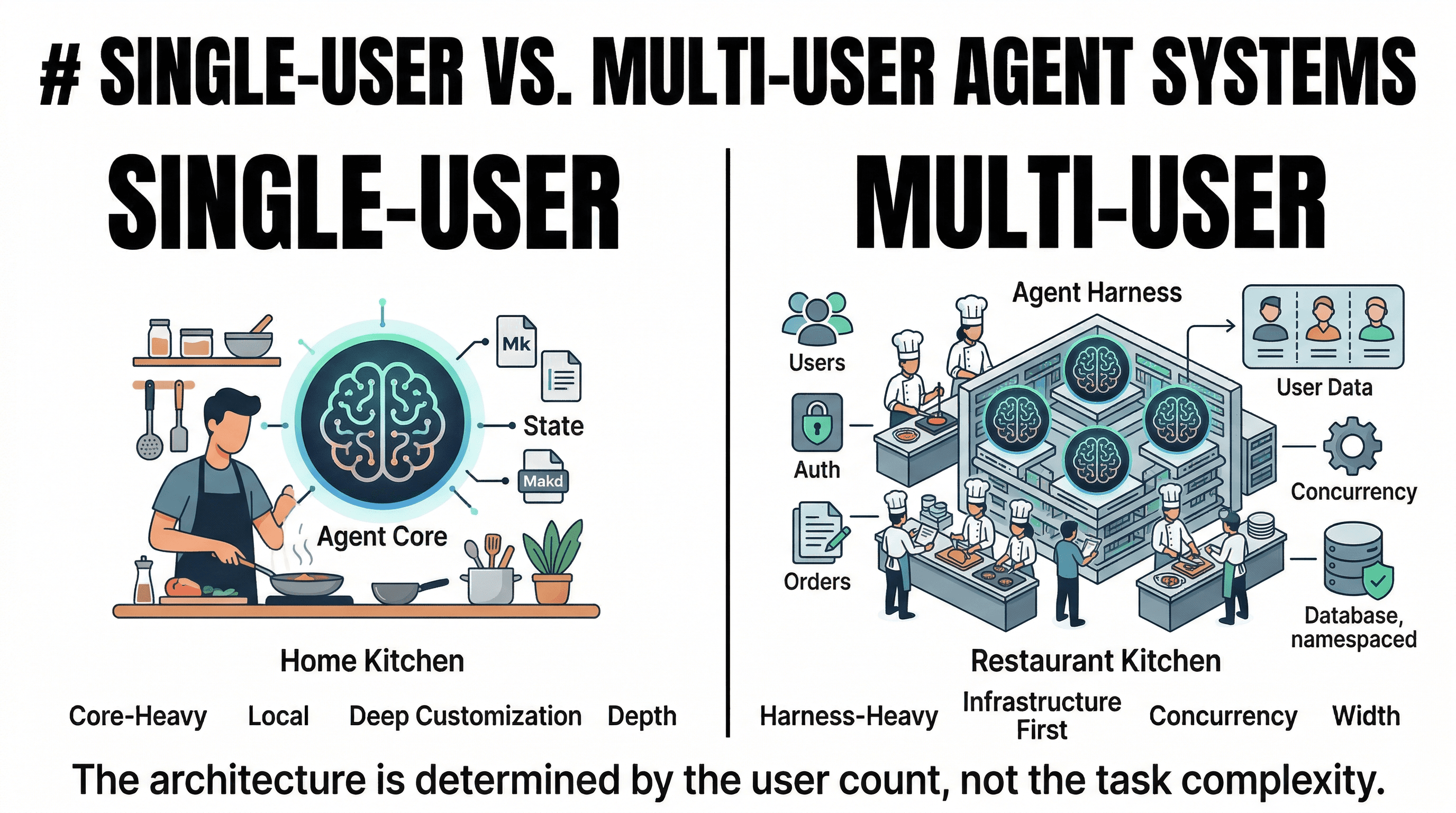
Single-User vs Multi-User Agent Systems
A structured breakdown of how AI agent architectures fundamentally change when you move from building for yourself to building for everyone.
1. Key Terminology
Before diving into the architectural differences, it helps to have a shared vocabulary. These five terms will anchor everything that follows.
| Term | Definition |
|---|---|
| Single-User Agent System | An agent environment designed and optimized for one primary user, typically running on a local machine or a single VPS. |
| Multi-User Agent System | A multi-tenant architecture designed to handle many concurrent users simultaneously, requiring strict isolation and security. |
| Agent Core | The "brain" of the framework. Manages planning, reasoning, tool calling, memory, and skills. |
| Agent Harness | The "factory floor" infrastructure surrounding the core. Handles authentication, permissions, quotas, and observability. |
| State Collision | A critical failure in multi-user systems where memory keys or caches leak context from one user's session into another, creating severe privacy breaches. |
2. The Core Analogy
The best mental model for understanding this distinction is a cooking analogy. The same ingredients and skills are involved -- but the operating environment is completely different.
| Single-User (Home Kitchen) | Multi-User (Restaurant Kitchen) | |
|---|---|---|
| Concurrency | Just you | 100 orders running in parallel |
| Rules | No rules, no overhead | Strict hygiene and safety protocols |
| Structure | Cook exactly how you like | Roles, stations, and defined workflows |
| Optimization | Taste and depth | Throughput and safety |
| Mistakes | Easily tolerated | Cost money and trust |
3. Single-User Agent Systems
Single-user systems are designed with a simple assumption: one person, one environment, full control. This unlocks a lot of freedom that multi-user systems simply cannot afford.
"Core-heavy and light on harness" the agent's intelligence is the star of the show, and the surrounding infrastructure is minimal.
Design Focus: Depth over Width
The goal is deep customization and rich personalization. Because no one else uses the system, every design decision can be tailored to a single person's preferences, quirks, and workflows.
Architecture: Simple and Local
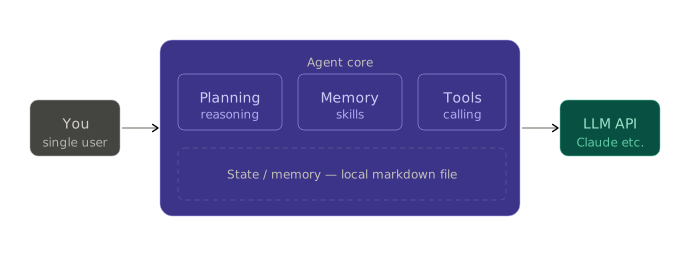
State and memory can live in something as simple as a local Markdown file. There is no need for databases, user ID namespacing, or distributed state management.
Tolerances: Forgiving by Nature
Token inefficiency is fine. Latency is acceptable. If the agent makes a mistake, the one user who notices is also the one who fixes it. This creates an extremely tight feedback loop that is excellent for rapid prototyping and iteration.
4. Multi-User Agent Systems
The moment you add a second user, the fundamental nature of the problem changes. You are no longer building an intelligent agent you are building infrastructure that happens to contain intelligent agents.
"Harness-heavy" the infrastructure must be built first. The agent cores simply act as plugins that run underneath it.
Design Focus: Width over Depth
The goal shifts from deep personalization to width, concurrency, guardrails, and protections. The system must work safely and reliably for many different types of users simultaneously, including ones who are actively trying to break it.
Architecture: Infrastructure First
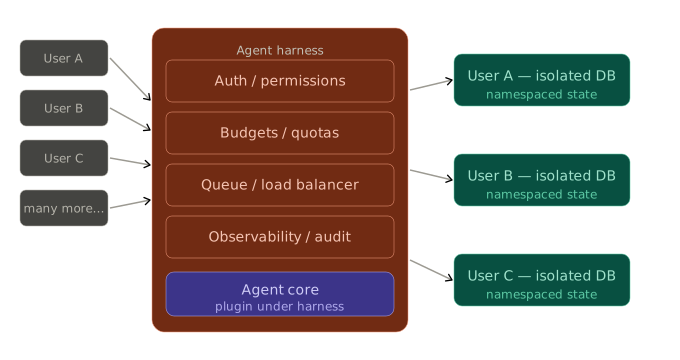
Simple storage like Markdown files becomes entirely ineffective. The harness handling authentication, load balancing, cost tracking, and audit logging has to be designed and built before the agent core is even considered.
5. What Breaks When You Scale
The transition from a single-user prototype to a production multi-user deployment is where most agent projects encounter serious, unexpected engineering challenges.
State Isolation and Collisions
If memory is not strictly namespaced per user, a shared cache will leak private context from one user's session to another. This is a severe privacy breach.
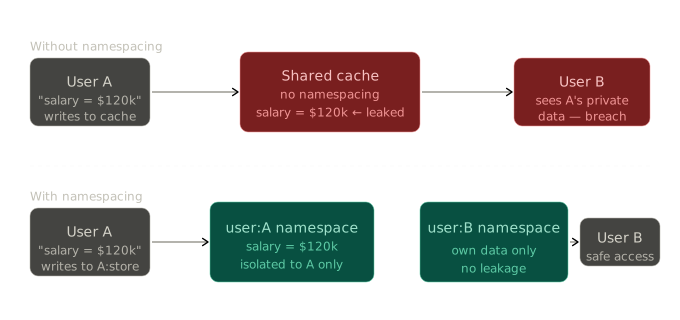
The fix is strict per-user namespacing in all state stores, combined with robust consent tracking and audit logs.
Cost Explosions
One user hitting an edge case in an inefficient workflow can rack up massive LLM bills. Systems require budgets, quotas, and graceful degradation paths to cap exposure.
Latency and Infrastructure
LLM call latency is manageable for one person but balloons with 20 to 30 concurrent users. Engineers must implement queues, timeouts, retries, and fallback systems to absorb the load.
Security and Abuse
Observability goes from optional to mandatory. Every new tool introduced creates new attack surface. Prompt injection and tool misuse must be defended against aggressively.
6. Summary: A Decision Framework
When you sit down to design an agent system, the first question is not "which LLM should I use?" it is: "how many users am I actually building for?"
The architecture is determined by the user count, not the task complexity.
| Single-User | Multi-User | |
|---|---|---|
| Architecture style | Core-heavy | Harness-heavy |
| State storage | Local file | Namespaced database per user |
| Cost controls | Not required | Budgets and quotas on day one |
| Security | Optional | Mandatory |
| Observability | Nice to have | Table stakes |
| Iteration speed | Very fast | Slower, more deliberate |
A single user means you can go core-heavy, stay loose on the harness, and iterate fast. Move to multi-user and the calculus flips entirely: harness first, state isolation always, cost controls on day one, security by default.
The engineering challenges that kill multi-user agent products are rarely about the AI itself. They are about the same distributed systems problems that have always existed isolation, latency, cost, and abuse just applied in a context where the failure modes are newer and less well-documented.
Build for the harness you need, not the one that feels easiest to skip.